

Home tutor for a 5 year old: what helps from age 3 to 6
Three-year-olds and six-year-olds need very different things from the adult sitting beside them. A good home tutor for 5 year old children plans in short bursts of play and changes the plan as your child grows. Here is what usually helps at three, four, five and six, one year at a time.
Ask a few parents in the colony park whether a small child needs a tutor yet, and you'll hear a different answer from each. The honest answer depends on age. A child of three and a child of six are in very different places, so this guide goes one year at a time.
If you'd rather just talk it over, tell us about your child, call us or WhatsApp us.
Which class is a 3, 4, 5 or 6 year old in?
It depends on the school. Each one names the early years its own way, LKG or KG, UKG or Prep, and sets its own joining age. A child born late in the year may be one of the youngest in the room. Use this as a rough guide; the class in your child's school diary is the one a tutor follows.
| Age, roughly | Usual class | What school is working on |
|---|---|---|
| 3 | Nursery | Sitting, sharing, one instruction at a time |
| 4 | LKG or KG | Staying with a hands-on task a bit longer |
| 5 | UKG or Prep | Letter sounds, numbers, two-step tasks |
| 6 | Class 1 | Notebooks, a reader, writing every day |
The Ministry of Education's page on NEP 2020 treats all of these years, from three to eight, as one foundational stage.
At three: play comes first
At three, most children are doing exactly what they should: playing, talking, and getting used to Nursery and to a few hours away from you. Plenty of three-year-olds never need a tutor at all. A child this age may stay with one thing for only a few minutes, and that's normal, not a problem to fix.
A tutor can help in two situations. One is a child who is very shy with adults and needs a calm, regular face to warm up to. The other is a home where nobody is free for unhurried play in the evening, perhaps because both parents get back late. Even then, the hour is stories, blocks and talk, not worksheets.
At four: listen to the class teacher
Four is often when the first comments come home from the PTM. Some are worth acting on: trouble holding a crayon, not following a simple instruction, or staying out of group activities. These usually respond well to gentle, regular help.
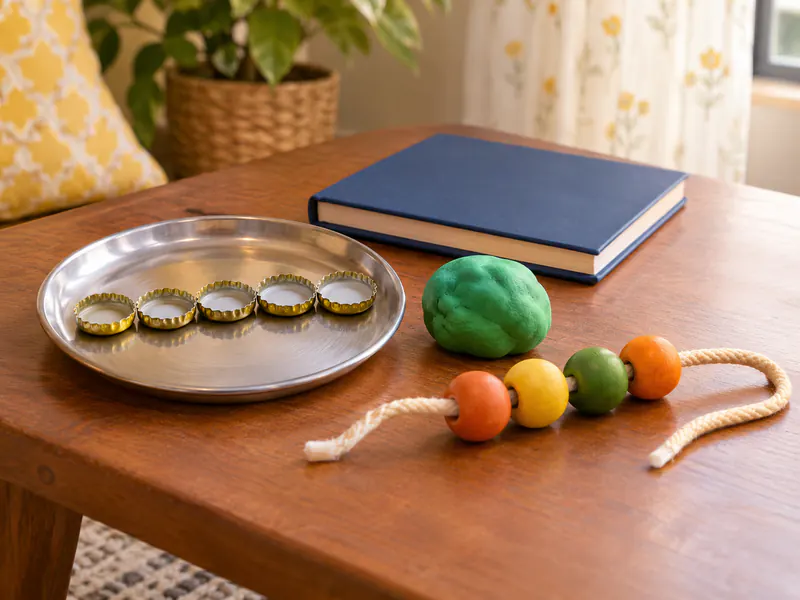
By four, many children can stay with a hands-on task a little longer than they could at three. A tutor builds on that with beads on a lace or a ball of play dough, each chosen for one small aim, like a stronger grip.
At five: when a home tutor earns its place
Five is usually UKG, and it's the age parents ask us about most. UKG homework starts to matter, Class 1 is close, and worksheets can turn into an evening battle. If that's happening at your dining table most days, a tutor can take the pressure off you both.
Schools at this stage work on letter sounds, forming letters, writing numbers and adding with objects. Many five-year-olds can now follow two steps and finish a short task at the table. Our guide to what LKG and UKG children learn goes through both KG years subject by subject.

Counting with spoons and beans
Five spoons in a row and a small bowl of dried beans make a whole maths lesson. Your child drops two beans in each spoon, counts them all, then takes some away. Tutors use kitchen things like this because adding with objects is exactly what UKG asks for.
At six: Class 1, notebooks and a reader
By about six, most children have moved into Class 1. Notebooks and a reader become part of every school day, and the class expects children to sit and write for longer. Our Class 1 home tutor page explains what that year asks for.
If letter sounds and forming letters still aren't secure, steady help now is much easier than catching up in Class 2. Six-year-olds still learn best by doing, talking and moving, though, so a good tutor mixes notebook work with short games.
What a tutor actually does with a young child

From the doorway it looks like play; up close it's teaching. The tutor might sit on the floor with a few bottle caps from your kitchen, some play dough and a picture book, and each one is there for a small aim. Your child often chooses where to start ("caps first, or the story?"), which helps a reluctant child join in.
Most Nursery and KG families we match choose about an hour, five days a week. That hour isn't one long sit-down. It's a string of short activities with a movement break between them, like hopping while counting or fetching things to sort. At three the pieces are short and many; by six they stretch out.
Praise goes to effort ("you kept trying"), and each activity ends while it's still going well. Timing helps too: a session after your child has eaten and rested usually goes better than one straight after the school van drops them home.
Arranging it is simple. We call you first, the tutor gives a free one-day demo class at home, and if you go ahead, the first month's fee comes to us in advance and from the second month you pay the tutor directly. Finding the tutor costs you nothing, and if the tutor stops coming in the first month we arrange another; how it works has the details.
How do you know your child is ready?
Reciting the alphabet or counting to fifty doesn't tell you much at this age. Settling and listening tell you more.
Your child may be ready when they can
- Sit with an adult for a few minutes on one activity.
- Follow a simple instruction, like "bring me the red block".
- Stay with a new adult while you're in the next room.
- Enjoy being read to, even a short story.
If your child isn't there yet, give it a few months and look again. UNICEF India explains why these early years matter so much for later learning.
We look for a tutor close enough to arrive on time and fresh, whether you live in Uttam Nagar, Janakpuri, Vikaspuri or Tilak Nagar, in colonies such as Vani Vihar, Kiran Garden, Janakpuri A Block, Vikaspuri KG Block and Krishna Puri. Our Nursery and KG home tutor page covers the whole pre-school stage. Komal Nuna, who runs Playway Teacher, has been teaching since 2005.
So, what does your child's evening look like?
Between three and six, how your child feels about learning matters more than how much they learn. Picture a normal weekday at home: is there a calm half-hour for play and stories, or does it get swallowed by the rush? If it's the second, send us your child's details and we'll talk it through. You always make the final choice of tutor. So which is it in your home, most evenings?


