Contents
Introduction to Parrot
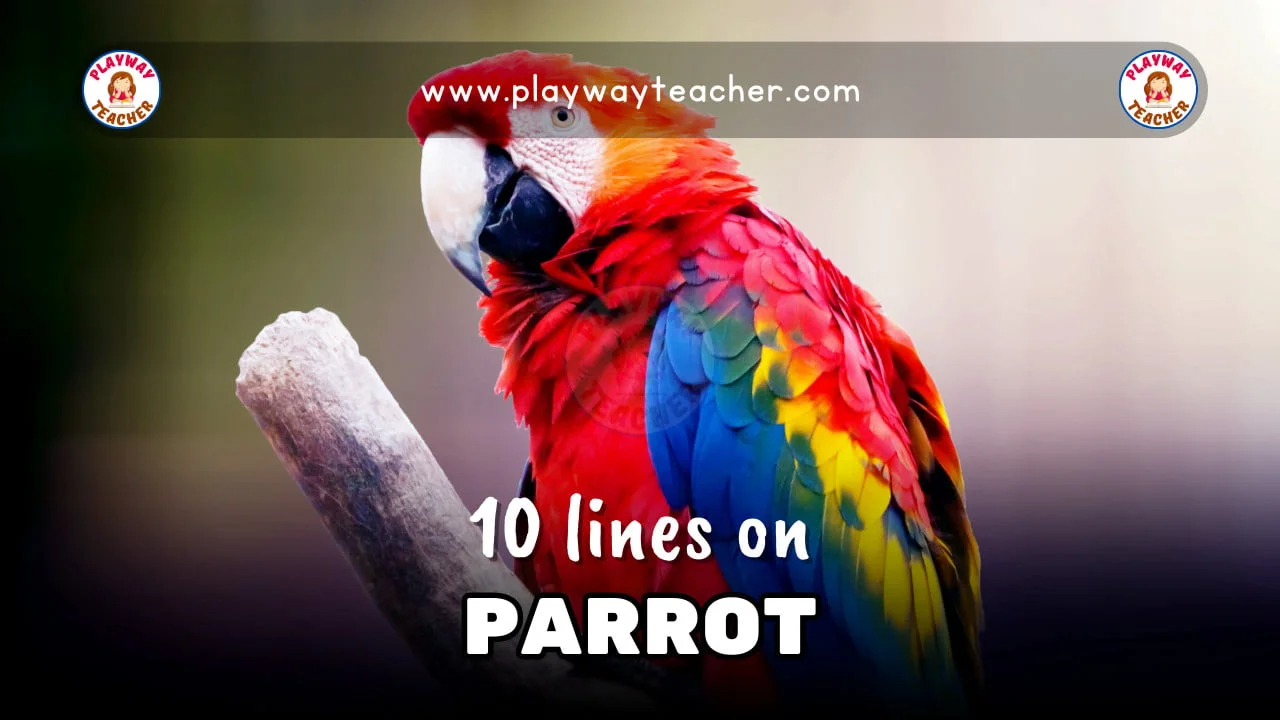
These 10 lines on parrot provide a colorful way for children to learn about one of the most intelligent birds in the world. Students often look for resources aligned with NCERT standards to understand the habits and features of common birds. Parrots are famous for their bright green feathers, curved red beaks, and their unique ability to mimic human speech.
Learning about birds is a popular topic for oral tests and nature assignments in elementary school. This topic helps young learners observe wildlife and appreciate the beauty of nature. These lines are helpful for students of CBSE, ICSE, and other State Boards who are exploring environmental studies. You can also explore 10 lines on various topics to enhance your general knowledge.

Quick Facts About Parrots
Green/Red
Seeds & Fruits
Mimicry
Curved Beak

10 Lines on Parrot for Class 1
These simple sentences help Class 1 students identify the parrot easily. They focus on the bird’s color, food habits, and unique beak.
- The parrot is a very beautiful bird.
- It has bright green feathers on its body.
- The parrot has a sharp red beak.
- It loves to eat green chilies and seeds.
- Parrots can fly very fast in the sky.
- Some parrots can talk like humans.
- They lay white eggs in a nest.
- Many people keep parrots as pets.
- They look very cute and colorful.
- I love to watch parrots on the tree.
10 Lines on Parrot for Class 2
Class 2 students can use these lines to describe the parrot’s home and behavior. The vocabulary is slightly more advanced to build language skills.
- The parrot is found in many warm countries.
- It uses its strong claws to hold onto tree branches.
- Parrots usually live in the hollow of a tree trunk.
- They like to eat fresh fruits like mangoes and guavas.
- A parrot can mimic the sounds of other animals.
- They are very social birds and live in groups.
- The male parrot often has a colored ring on its neck.
- Parrots have a loud and harsh voice.
- They use their beak to crack open hard nuts.
- We should not keep them in cages for our fun.
Get expert home tuition for English and Science in Uttam Nagar, Vikaspuri, Dwarka & Janakpuri.
10 Lines on Parrot for Class 3
For Class 3, we introduce more details about different species and the parrot’s diet. These lines emphasize their intelligence and natural habitat.
- Parrots are known for their vibrant and colorful plumage.
- There are many different types of parrots found worldwide.
- They have a strong, curved beak that is very powerful.
- Most parrots live in tropical rainforests where it is warm.
- They are intelligent birds and can learn tricks easily.
- Parrots are omnivores, meaning they eat both plants and insects.
- They hold their food with one foot while eating.
- The lifespan of a parrot can be very long.
- They play an important role in spreading seeds in forests.
- Hunting parrots for pets has reduced their numbers in the wild.
Wild Parrots vs Pet Parrots
| Wild Parrot | Pet Parrot |
|---|---|
| Lives freely in forests | Lives in a cage or house |
| Flies long distances daily | Cannot fly very far |
| Hunts for its own food | Relies on humans for food |
| Lives in large flocks | Lives alone or with humans |
| More afraid of humans | Friendly with humans |
| Natural bright colors | Colors may fade slightly |
| Screams to communicate | Mimics human words |
| Nests in hollow trees | Sleeps on a perch |
| Faces predators like snakes | Safe from wild predators |
| Helps nature grow trees | Provides company to people |
10 Lines on Parrot for Class 4
Class 4 students dive deeper into the science of parrots. These lines explain their unique feet structure and social behavior.
- Parrots belong to a large group of birds called Psittaciformes.
- There are more than 390 different species of parrots.
- Most parrots are native to the rainforest regions.
- They are very social and communicate with loud squawks.
- Parrots have feet with two toes facing forward and two backward.
- This feet structure helps them grip branches and food tightly.
- Their diet consists of flowers, fruits, nuts, and small insects.
- The Kakapo is a unique parrot that cannot fly at all.
- Parrots communicate using visual signals and sounds.
- They are the only birds that can eat with their feet.
Get experienced home tutors for all subjects in Uttam Nagar, Vikaspuri, Dwarka & Janakpuri.
10 Lines on Parrot for Class 5
In Class 5, students learn about the parrot’s adaptation and conservation. These lines explore why some parrots are disappearing.
- Parrots are highly intelligent and can solve simple puzzles.
- Some species of parrots are endangered due to habitat loss.
- They have a long lifespan, with some living over 60 years.
- Parrots in captivity need a lot of attention and care.
- The African Grey Parrot is famous for its ability to speak clearly.
- They are omnivore feeders but prefer seeds and nuts.
- Illegal trading of exotic birds hurts the parrot population.
- Parrots use their strong beaks as a third limb for climbing.
- Destruction of their habitat is a major threat to their survival.
- Conservation programs are helping to protect wild parrots.
10 Lines on Parrot for Class 6
Class 6 students analyze the biological features of parrots. These lines cover topics like zygodactyl feet and their ecological role.
- Parrots have zygodactyl feet, which are perfect for gripping perches.
- They are intelligent vertebrates capable of complex problem-solving.
- Research shows that parrots have cognitive skills similar to small children.
- They modify sounds using their throat muscles rather than vocal cords.
- Parrots aid in seed dispersal, helping forests regenerate.
- The biodiversity of parrots is highest in Australasia and South America.
- Deforestation poses a critical threat to their nesting sites.
- Unlike most birds, parrots have a very long developmental period.
- They contribute to the biodiversity of the ecosystem they inhabit.
- Studying parrots helps scientists understand the evolution of vocal learning.

Final Thoughts
The parrot is a fascinating creature that captures our imagination with its intelligence and beauty. By studying these 10 lines, students can learn to respect wildlife and understand the importance of preserving natural habitats. You can find more detailed articles in our essays category to continue your learning journey.
Whether you are writing a speech or preparing for a test, remembering these facts about the parrot will surely help you score well. We hope these simple points make your study time enjoyable and effective.
Have you ever heard a parrot talk? Leave a comment below and tell us what it said!
Fact-Checked


Frequently Asked Questions
Was this helpful?
0 / 0

Playway Teacher simplifies school topics into easy, exam-ready notes. Curated by a former school teacher and active tutor with 15+ years of experience, our content is designed to help primary and middle school learners excel.